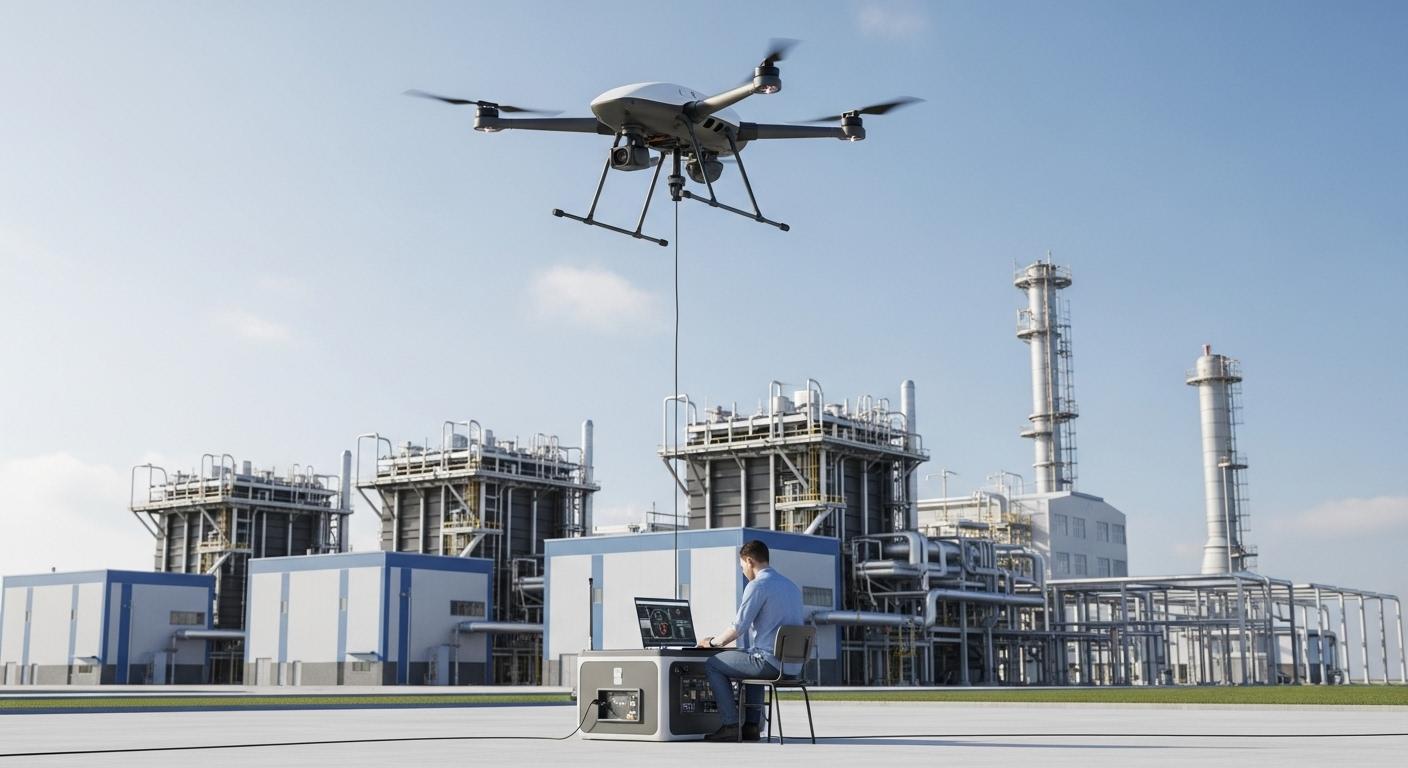
A device, connected by a wire, monitors your workspace as night gently falls. This is neither a coincidence nor a passing fad. A stark, almost cold, undeniable reality is undeniable: aviation security is changing, you can feel it, and it is indeed the tethered aircraft that sets the pace. You want reliability? The promise is already before you; vigilance is present, continuous, surprising in its consistency, supporting teams that can no longer afford to fail. The answer to the question? You experience it every night, every moment: surveillance never leaves your skies; the tethered device provides reassurance while the world sleeps.
The technology that builds modern aviation safety
The scene has changed. Do you remember the initial models, reserved for the military, designed to discreetly survey hazardous areas? These unobtrusive machines were already capturing live images without being noticed. The propellers went unnoticed, but everything quickly came to a halt as the battery drained faster than a glass of water after a marathon. The unlicensed drone then appeared at construction sites, festivals, and power plants, with seductive agility, but it always ended up coming down to the ground. Fifteen minutes, thirty minutes, rarely longer.
Have you seen this : How Does Emerging Hardware Technology in the UK Affect Data Privacy?
There was the crossing of the cable. You discover the aircraft whose energy doesn’t drop. The anecdote unfolds naturally. In Marseille, a security chief recounted, half-fascinated, half-amused, how his tethered device served as an “infallible night watchman, the one who doesn’t ask for breaks or coffee.” The nights pass, surveillance takes hold, and no one stresses out in front of a black screen anymore. That’s the experience as it’s lived in the field.
You then explore all the benefits, and it becomes relevant to consult the page ” the advantages of using a tethered drone for surveillance” as the subject remains topical, especially for those in charge of sensitive sites.
In parallel : How Does Emerging Hardware Technology in the UK Affect Data Privacy?
| Characteristic | Free drone | Wired drone |
|---|---|---|
| Autonomy | Limited by battery | Unlimited (continuous power supply) |
| Mobility | Highly mobile, wide range of action | Stationary or restricted movement |
| Data security | Vulnerable to interference | Stable and secure wired transmission |
| Common use | Rapid intervention, timely inspection | Long-term surveillance, perimeter protection |
The history and progression of aircraft in surveillance
The drone, in the 1960s, ventured into the unknown, all to save lives behind enemy lines. It’s not just a bygone era; it’s a solid foundation, enriched by decades of improvements. You’ve probably seen these devices circling at urban events or flying alongside factory halls, relentlessly capturing everything. Then came a turning point: the tethered model. This is the arrival of a device that stays put, never loses its tether, feeds continuously, and maintains its position for as long as necessary, sometimes for several days if needed.
The differences between wireless and wired devices
If you look closely, the technological leap is obvious. The wireless device allows for all sorts of maneuvers, improvising, but its battery drains quickly. In contrast, the wired version stays put, locks its focus, stabilizes every image, transmits a constant power supply via the cable, and, most importantly, protects your images from prying eyes or hacking. The anxiety of a dead battery disappears; battery life becomes secondary. The feeling of security changes everything, especially for operators stationed in critical areas.
The technology behind tethered aerostats: innovations and components
The device, suspended on its cable, exudes robustness. You plug in a cable, and the machine never falters. On the ground, the installation is brimming with sophistication: communication module, fault protection, spare cable, and even backup batteries to leave nothing to chance. The user, seated in front of their screens, observes without missing a single pixel, benefiting from a high-definition camera and thermal sensors eager to detect anomalies. Nothing is left to chance; everything hinges on reliability, at every level.
The biggest manufacturers are constantly innovating. You see models equipped with radar, lidar, and ultra-fast, protected transmission modules, even in the event of storms or disruptions. The underlying principle remains the same: every detail counts, no weakness is tolerated, vulnerabilities are costly, and the security of critical sites cannot afford any delays. Manufacturers strive for perfection. Requirements increase year after year, and this is reflected in every component.
The integration of artificial intelligence and instant analytics
The world of surveillance is undergoing a transformation. Artificial intelligence is disrupting all established practices. Operators, overwhelmed by the sheer volume of images, now rely on precise algorithms that detect every intrusion, every suspicious movement, every unexpected behavior. Automatic vigilance, sharp and lightning-fast. You are no longer watching a static video sequence, but at the heart of a true digital system where responsiveness is paramount.
You do more, better, without a break. Real-time analytics and augmented detection are changing the pace of work, breaking down routines, and reducing the psychological pressure on human teams. France believes in it, the European Union is discussing it and adapting new standards that support the integration of intelligent systems (source: easa.europa.eu).
The advantages of wired systems for aerial surveillance
The flight duration eliminates all concerns. Where a conventional drone would return to its starting point to recharge, the cable-powered device remains stationary for many hours. Major events can breathe easy, and the monitoring of Seveso-classified sites also benefits from the stability, as does the operator who no longer hears the low battery warning signal. Cable transmissions prevent any hacking attempts and maintain a stable data flow, even when the sky is buzzing with other signals.
A surprise: the administration is smiling. Regulatory aspects are simplified, as this type of aircraft more easily meets the DGAC’s criteria, and the FAA appreciates this added level of technical safety. Previously, excessive paperwork was tiresome; now, administrative issues are diminishing. Fewer permits to request, less worry for local residents, fewer interventions from the authorities: the system is becoming integrated into practice without creating neighborhood conflicts.
The multiple uses of wired connections for security
You wouldn’t believe everything that goes on behind the scenes. The inner workings of a Parisian festival unfold under the watchful eye of a suspended camera, which detects anomalies and alerts the police to any unusual behavior. At the Spanish border, the aircraft hovers on its beacon, almost forgotten, yet it doesn’t miss a single movement, whether agricultural or human. At a dam, a camera anticipates an incident, triggering the control room with a single filmed movement.
| Use | Main advantage | Typical example |
|---|---|---|
| Event security | Constant observation of the site | Festivals, stadiums |
| Border surveillance | 24/7 monitoring | Border areas |
| Critical infrastructure | continuous monitoring | Dams, power plants |
A few scenes are etched into memory. Rescuers deploy the tethered aircraft above a burning forest, while the video feeds live into the decisions made at the crisis center. In a city, a missing person is reported: the camera defines a precise perimeter, directing the teams with meter-level accuracy. These are small technological victories, almost invisible if you don’t listen closely or lean over the screen.
- Critical infrastructure monitoring is always active
- Uninterrupted mass event monitoring
- Tactical support during complex incidents
- Protection of border areas over long periods
The regulatory landscape and the contentious issues for the wired model
There is no uniform text. Each country adjusts its protocols and changes the rules according to the sensitivity of the situation (source: drone.civil-aviation.gouv.fr). In France, there are well-defined thresholds: altitude limits, requirements based on the concentration of the public, and costly inspections to obtain approval. The United States inspects equipment, certifies video streams, and scrutinizes the security of transmissions. The retention of recordings also raises concerns, as do image encryption and the protection of individuals captured on screen.
Civil society observes, judges, and demands. Respect for privacy permeates every decision, every procedure, every display. Operators provide warnings, explanations, and information on-site. Trust doesn’t fall from the sky; no one grants it without a clear explanation. Some are proactive: enhanced team training, commitments to confidentiality, and immediate shutdowns if ethically required. A feeling prevails: oversight is increasing in the right direction. In France, the CNIL (National Commission for Information Technology and Civil Liberties) has just updated its guidelines (source: cnil.fr).
The brilliant and innovative companies in the wire market
We encounter several leading players. DJI is working on robust models that appeal to both industrial companies and public authorities. Drone Volt, the French brand, sends its devices to monitor major sites across the continent and protects its innovations with several patents. Elistair, for its part, offers automated flight management: it takes off on its own, maintains its position, and returns as soon as an anomaly arises, without any human verification of the operation.
Wired networks also attract service companies, ready to support their clients from startup to maintenance. Support and personalization – that’s what provides reassurance. User training and guaranteed 24/7 technical support are highly valued. Festivals are secured, nuclear power plants are protected. Innovations reach these operators almost before they even appear on the civilian market. This synergy is paying off.
Sometimes, on the docks of Le Havre, the spotlight of the wired camera cuts through the night. An officer, into his walkie-talkie, exults: “We saw everything, anticipated everything, nothing escaped the camera.” On the ground, fatigue fades in the face of a regained sense of control.
Trends in 2025 for wired surveillance
The year 2025 is on the horizon: engineers are focusing on miniaturization, discretion, and devices that are undetectable above a crowd or tucked away against a wall without attracting attention. Artificial intelligence is transforming even the simplest model, enabling it to track a suspicious target, recognize a license plate, or prevent an accident before it happens. Hybrid batteries are becoming even lighter, combining the power of wired connections with the flexibility of mobile devices.
Standards are changing everywhere. Europe and other continents are aligning their positions, standards are converging, red tape is decreasing for border operators, and installations are expected to be more streamlined. Some governments are betting on a surge in security. Cities are adopting coordinated clusters: aircraft, cameras, and sensors already share urban networks. Who will take control of this vastly smarter sky tomorrow?